
Discover the Impact of "Block Scoring" in Pickleball: A New Way to Understand the Game
In the world of pickleball, the final score often doesn't reveal the true story behind a game. This is where block scoring comes in, an innovative approach that brings to light the twists and turns and dynamics of the game in a way that the traditional scoring method cannot.
Instead of simply recording the final result, block scoring highlights how each point was earned, providing a richer and more detailed view of the matches.
What is "Block Scoring"?
Block scoring is a technique that groups points into consecutive blocks, instead of simply listing the final results. Each block is labeled alphabetically and alternates between teams as they score.
For example, instead of simply stating that "Team A won 11-5," block scoring could provide more details:
- Block A: Team A scores 4 points
- Block B: Team B scores 2 points
- Block C: Team A scores 3 points
- Block D: Team B scores 1 point
- Block E: Team A scores 4 points to win the game.
This technique already offers a clearer and more engaging view of how the game unfolded, highlighting the turning points and the strategies employed by each team.
Analysis of a Complete Match
By applying block scoring to an entire match, we can see how different plays within the match reveal unique dynamics and exciting lead changes.
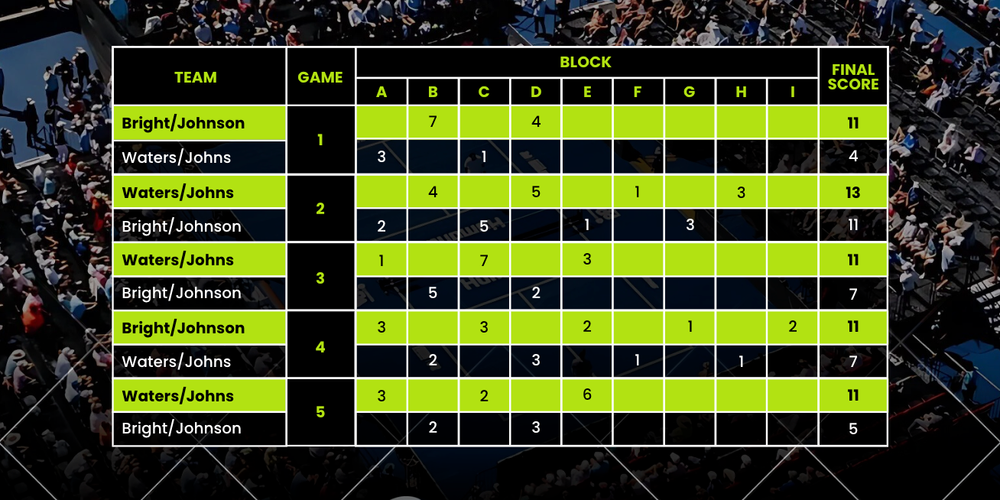
Consider a game where Team Bright/Johnson opens with a 7-point run. Then, during the second game, Waters/Johns and Bright/Johnson alternate long scoring runs, creating a close battle.
Finally, in the decisive game, Waters/Johns make a 7-point run, taking control, and close the match with a dominant final block of 6 points. This detailed analysis illustrates how block scoring can enrich the understanding of the game.
When does "Block Scoring" stand out?
Block scoring is particularly effective in two scenarios: very unbalanced games and close battles. In unbalanced games, a single block of 6 or 7 points can quickly decide the game.
On the other hand, in close games, with scores like 15-13, there can be more than 10 blocks, each representing a crucial change in momentum. This is similar to other sports, such as volleyball and tennis, where point sequences are monitored for strategic analysis.
Allowing fans and analysts to see these momentum fluctuations is one of the great advantages of block scoring .
Advantages and Disadvantages of Block Scoring
Block scoring offers several advantages, including capturing the flow of the game and visualizing the scoring dynamics in a highly visual and engaging way.
- Great for narratives and analysis.
- Useful for broadcasters, coaches, and statistics enthusiasts.
- Easy to implement in professional matches.
However, there are disadvantages. Block scoring can be more complex to read quickly and is not intuitive for those who are not trained. Additionally, it can take up more space, especially in long games.
Who Benefits from "Block Scoring"?
Block scoring is ideal for TV broadcasts, coach analysis, and fan engagement. It adds a perfect layer of depth to match recaps on social media or newsletters.
For pickleball fans watching live broadcasts or replays, the block scoring display provides a high-level perspective on the dynamics of the game, similar to the use of scoreboards in televised baseball games.
Pickleball is a game of momentum, and block scoring helps bring that characteristic to life.
Explore "Block Scoring" in Your Game
Now that you know the power of block scoring , why not try applying this technique to your own game analysis?