

How to Vary Your Dinks in Pickleball to Unsettle Your Opponents
The key to winning dink battles in Pickleball is unpredictability. In the dynamic world of Pickleball, dinks are an essential strategy for controlling the game and unsettling opponents. This article will guide you through dink variation techniques, revealing how they can be your best weapon on the court.
We'll explore how diversifying your dinks in terms of spin, speed, angles, and positioning can confuse your opponents and open up new opportunities for attack. Get ready to improve your game and surprise your opponents with unpredictable moves and creative strategies.
The Power of Variety in DINKS
Variety in your dinks is crucial to keeping your opponents off balance. By moving and varying your dinks, you become a more unpredictable and flexible player. This unpredictability not only confuses your opponents but also gives you the ability to adapt your game strategy according to the unique skills of your adversaries.
To maximize this strategy, it's essential to never repeat the same DINK . This can be achieved by varying aspects such as:
- Spins: Use slice, topspin, and sidespin to diversify your shots.
- Speed: Alternate between fast and slow dings to break the rhythm of your opponents.
- Angles and Depth: Constantly change the angle and depth of your dinks to keep your opponents guessing.
Advanced Dink Techniques
In Pickleball, understanding the difference between unintentional and intentional dinks can elevate your game. While unintentional dinks are more about returning the ball, intentional dinks are executed with the intention of putting pressure on opponents and gaining an advantage.
Aggressive dinks, characterized by spin, extra speed, or strong angles, can be used to put your opponents at a disadvantage. The choice between an aggressive or a more passive dink should be based on the quality of the hit you received from your opponent.
For example, if your opponent performs an unintentional dink, you have the opportunity to respond with a more aggressive dink. Conversely, if you find yourself at a disadvantage after an aggressive dink from your opponent, a more passive dink might be the best response to regain control.
Diversity of Dink Variations
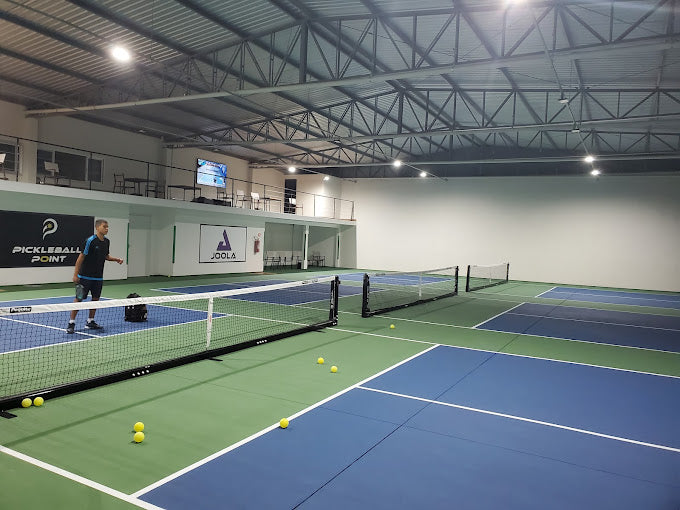
Integrating different dink variations into your game is an effective way to disrupt your opponent's rhythm. Cross-court dinks are popular due to their greater range of play, allowing you to play at a natural angle and with more space on your opponent's court.
However, to maintain unpredictability, it's important not to rely exclusively on cross-court dinks. Straight dinks can surprise opponents and prevent them from settling into a predictable pattern. Furthermore, dinks in the middle of the court can cause confusion among opponents, especially if they are not used to playing together.
These variations not only keep their opponents on their toes, but also open up opportunities for subsequent attacks, exploiting gaps in the opposing defense.
Strategic Dinks to Pressure Opponents
Dinks aimed at the opponent's feet are an effective tactic for applying pressure, making it difficult for them to respond aggressively. When executed precisely, these dinks force the opponent to defend themselves in an uncomfortable position.
Another effective strategy is to direct dinks towards your opponent's backhand, as many players have weaker shots on that side. This can force errors and create opportunities for you to take control of the point.
Short dinks, which are executed immediately after the ball bounces, reduce the opponent's reaction time and help maintain an aggressive position on the no-volley line. This technique is especially useful against opponents who use spin and other actions on the ball.
Creativity and Surprise in the No-Volley Zone
Being creative on the no-volley line can be the difference between winning or losing a point. The no-look dink, for example, is a shot that can surprise your opponents, using instincts and muscle memory to execute the shot without looking directly at the ball.
These creative variations not only add an element of surprise to your game, but also keep your opponents guessing. The mission is clear: don't repeat the same dink twice . By mixing spins, speeds, and angles, you increase your chances of success on the court.